Tangem Pay for Cold Storage Users: Spend Without Sacrificing Custody Discipline
If you take cyber resilience seriously, you already know the failure mode: convenience wins once, and suddenly your stack is sitting on an exchange because you needed to book a flight or pay a vendor. Tangem Pay is not a magic “off-ramp.” It is a segmented spend rail—a virtual Visa inside the Tangem ecosystem—funded with USDC on Polygon, while your primary cold strategy stays intact.
The operational security problem: “just this once” on a CEX
Deposit risk is cumulative. Every time you move assets to a custodian for a card or wire, you reintroduce counterparty exposure, account takeover surface, and policy exceptions your security team cannot easily audit. For individuals and small teams, the same pattern shows up as habit drift: what started as a one-time withdrawal becomes a standing balance.
Tangem’s product framing for Tangem Pay targets a different workflow: keep long-term custody in the hardware-backed wallet model you chose, and fund only a bounded spend bucket that routes through Visa, Apple Pay, and Google Pay—subject to program rules and regional availability.
Threat modeling: treat Tangem Pay as a hot segment
That mindset aligns with how we talk about cold storage architecture for enterprises: segmentation, least privilege, and evidence of controls. You are not “moving to hot storage by default”; you are explicitly sizing a hot allowance.
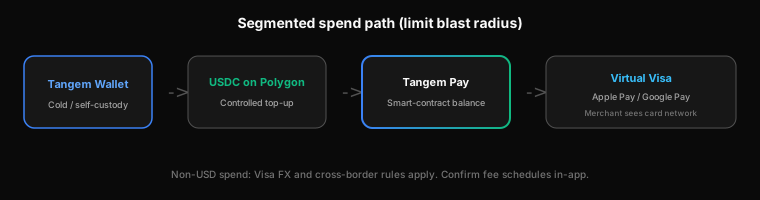
How the rail fits your custody stack (diagram)
From a security reviewer’s perspective, the question is simple: where do keys live, and where does value become spendable? Tangem Wallet remains your hardware-backed custody story. Tangem Pay holds a Polygon USDC balance in a smart-contract account you control (per Tangem), then bridges that to card settlement. Merchants see Visa; they do not see your cold workflow.
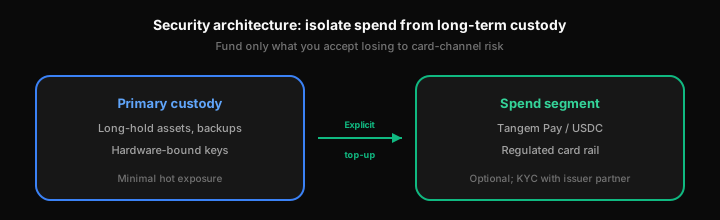
“Vault stays vaulted”: isolation, not slogans
Effective custody hygiene means your primary keys and long-hold positions do not float through every point-of-sale terminal. Tangem describes Tangem Pay as optional inside the same app as Tangem Wallet—so the win, for security-conscious readers, is operational separation: you choose how much USDC enters the spend segment.
If you are comparing hardware form factors first, see our Tangem hardware review (zero-seed model) and the broader 2026 hardware wallet audit before you expand into card rails.
KYC boundary: why Rain matters to compliance-minded holders
Tangem states that Rain performs KYC as an independent issuing partner and that Tangem does not see your personal KYC data for that process. For teams documenting third-party processors, that separation is worth capturing in your vendor notes—alongside Paera LLC, Third National, Sumsub, Elliptic, and Visa as named program participants on Tangem’s site.
We are not your counsel. Map this stack to your own regulatory obligations (including regional crypto and payments rules) before deploying it for business spend.
Funding hygiene: Polygon USDC is the gate
Tangem Pay spending is funded with native USDC on Polygon at launch—not “whatever token is in your cold bag.” That means your security process must include bridge or exchange withdrawal checks: correct chain, correct contract, destination verification, and fee awareness (including Polygon gas, which is a network cost—not a Tangem line item).
Getting that step wrong is how funds disappear—no different from mis-tagged enterprise backup jobs, except irreversible. If you already use Tangem for other workflows, compare with Smart Gas and Yield Mode so you do not confuse product boundaries.
Three activation steps (summary)
- Create the virtual Visa inside the Tangem Wallet app.
- Complete KYC with the issuing partner (Rain) per in-app flow.
- Top up with Polygon USDC, add to Apple Pay or Google Pay, spend where Visa is accepted—mind FX if not in USD.
When Tangem Pay is a good fit—and when it is not
- Good fit: You want bounded day-to-day spend, travel, or subscriptions without parking operating cash on an exchange.
- Good fit: You already standardized on Tangem for seedless hardware workflows and want one vendor footprint for app-based services.
- Poor fit: You need anonymous spending, zero identity surface, or treasury-scale liquidity without issuer limits—this is a regulated card product.
- Poor fit: You expect ATM cash-out or multi-chain direct spend today—Tangem documents virtual-only cards at launch and no ATM use yet.
Full Q&A: fees, countries, issuers, limits
We maintain a dedicated FAQ for security and compliance teams who need scannable answers: Tangem Pay FAQ (2026) — fees, KYC, geography, card program.
Harden the stack, then fund the spend segment
Order Tangem hardware for primary custody, download the app to explore Pay when eligible in your region, and keep top-ups intentional.
Download Tangem App → Order Tangem (Code CRYPTOVAULT) →Official Tangem Pay page →
Disclosure: CryoVault Solutions earns affiliate commissions on qualifying Tangem purchases through our links. We publish this because the product maps to real custody-segmentation problems—not because every reader should enable card rails.
Freshness: Features, fees, supported regions, issuer partners, and regulatory interpretations change. Verify all operational details in the Tangem app and on tangem.com before moving funds.